
Making theatre green
Headlong’s Producer Zoë Robinson on The Theatre Green Book and the future of theatre making - recycled and reused from what’s come before…
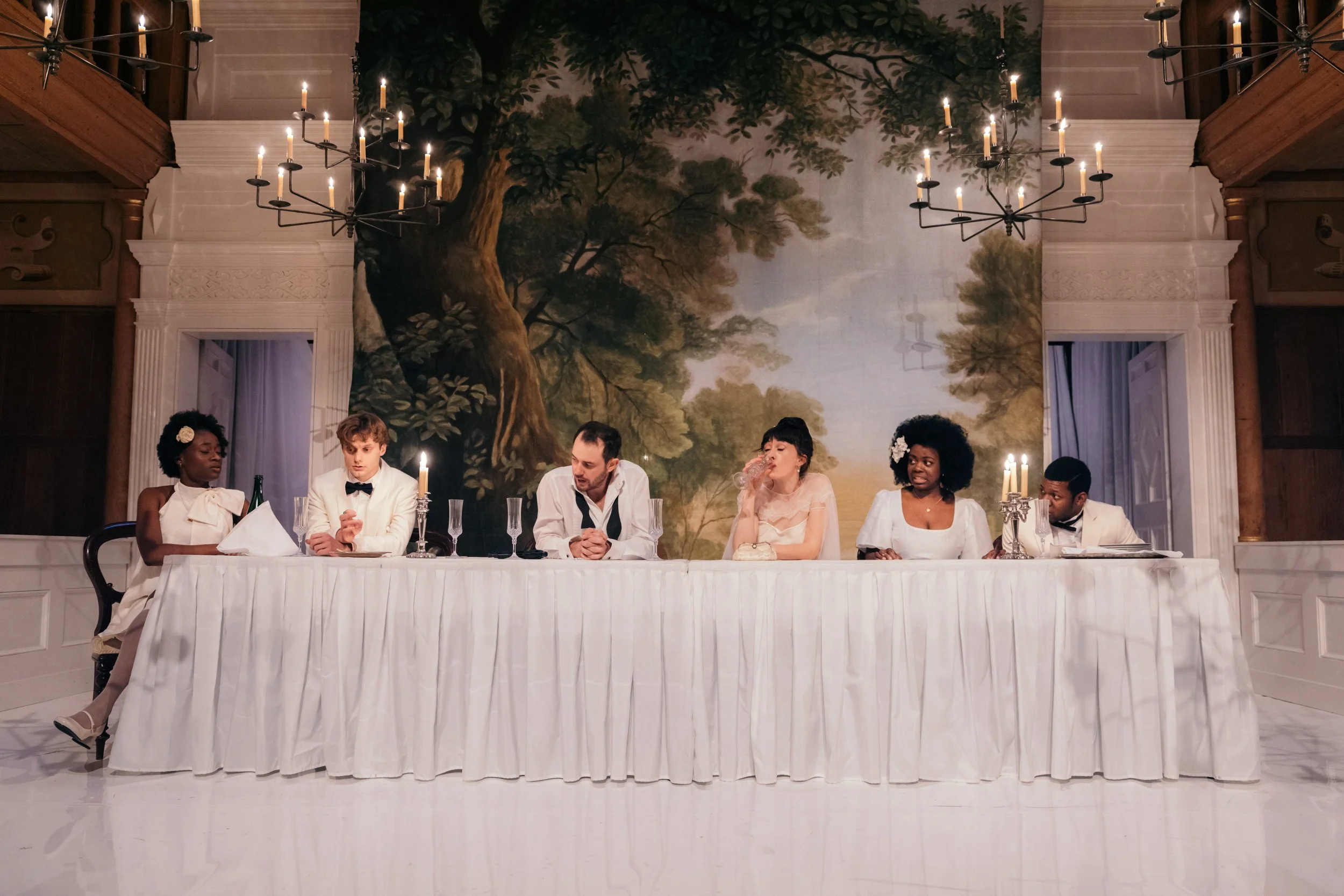
A Midsummer Night’s Dream. Designer: Max Johns. Image: Helen Murray
What’s next for that old kitchen?
Not long into her career, our Producer Zoë found herself facing a pretty standard challenge for anyone working in Fringe Theatre. The play she was producing was set in a kitchen, but she had zero budget for set. Then one day, a chance conversation at her day job reaped rewards. The office was getting a new kitchen, and the old, perfectly decent one was headed for a skip.
A phone call to a carpenter friend, and some hard graft later, the kitchen was stripped out and rebuilt on stage.
“It was one of the most advanced, beautiful sets I’d made up to that point, created pretty much for free”. And it had come about by me asking the simple question, ‘what’s next for that old kitchen?’”
For us at Headlong, this instinct to see the potential and future life in the materials around us sits at the heart of the Theatre Green Book – the source of one of the biggest shifts happening in the world of theatre right now.
First published in 2021, the Theatre Green Book brought together existing work from across the UK Theatre industry into a shared framework and set of guidelines. Since then, it’s driven significant changes to how theatre productions are designed, budgeted for and built – to reduce their environmental impact.
The publication of the Green Book coincided with Zoë’s arrival at Headlong.
“It felt like a natural shift. At Headlong, we see our work and how we make it as being inextricably linked with both social and climate justice. Artistically, we ask big questions.
And what is climate justice if not one of the biggest questions of our time?
We know that environmental justice is important to our audiences – they tell us! They want to invest – quite literally by buying a ticket - in work that is socially and environmentally conscious. We saw that with the response to A Play for the Living in a Time of Extinction. But we also know that people want to see quality theatre that explores lots of other stories and ideas without it being the central subject matter.
The Green Book allows us as production and technical teams to offer this, while also developing our knowledge and collecting the data that shows us how we’re doing and where things can be improved.”
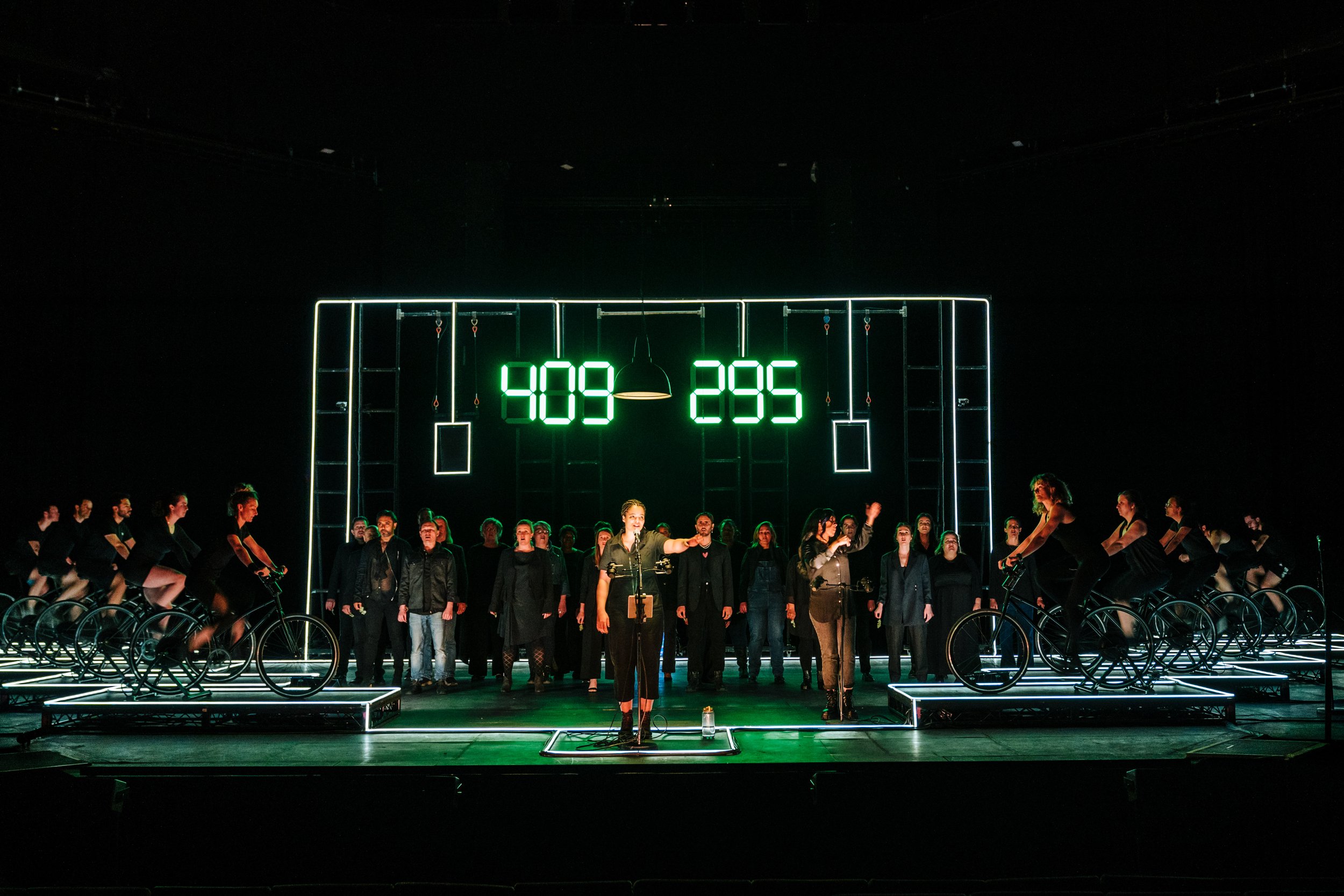
A Play for the Living in a Time of Extinction. Set design: Moi Tran. Image: Helen Murray.
How does it work?
The Theatre Green Book framework is shaped around three areas - Sustainable Productions, Sustainable Operations and Sustainable Buildings. Each of those three areas has three steps (Basic, Intermediate and Advanced) for organisations to follow on their transition journey to achieving net zero.
For Zoë specifically, the Green Book sets out clear targets for how much a production’s materials should be reused or recycled:
BASIC - 50% of everything on stage must be reused or recycled, and 65% must be stored or used again afterwards
INTERMEDIATE - 60% reused and 70% to be used again
ADVANCED - 75% previous use vs 80% being used in the future
This then must be built into the production.
“We’re aiming for at least Intermediate on all of our Productions. So, as you can imagine, if well over half of everything you see on a Headlong stage must be at least second or third hand, we are having to think very differently from the off about how a show is put together.
That means factoring things into the production timelines at its earliest stages. Before a single piece of set or design is agreed or sourced, we are asking ourselves, ‘where has this come from and where will it go afterwards?”
This is where the Green Book is changing things.
Crunching numbers
Zoë explains that alongside a financial budget – a Producer's main tool when constructing a show - we now run a Green Book calculator. This is a carbon budget tracker where we can log the environmental cost of every decision we make.
“So, one of the big changes we’ve seen is; when looking at design budgets, the proportion of costs is going less on materials, but more on the people, which is a vital part of sustaining work within the industry.
A costume supervisor might spend less on materials and making, sourcing them from vintage and second-hand shops instead, spending more of their time and our budget to pay them, on the skilled, exacting work of finding the perfect costumes for the show.”
A Fringe approach
In many ways Zoë feels that The Theatre Green book has taken her experience of making theatre back to where she started.
Back then, her approach involved a lot of trawling through her parents’ sheds and attics to source sets, props and costumes for the work she was making. But as that career developed into more established mainstream or commercial spaces, the processes around set and design shifted.
“I tend to explain the shift the Green Book is trying to make, as moving away from where Theatre has found itself – in a ‘linear economy’ that finds, uses and discards as a process – back to something more like that Fringe experience – a circular economy, where the materials are sourced to keep moving around the industry, being reused in different ways, telling different stories on different stages.
Back then, I feel like we were doing a lot of that, but we didn't know how much we were doing or the difference it was making. The Green Book calculator means that we can tell how much carbon we are saving by taking that kitchen from the skip.’
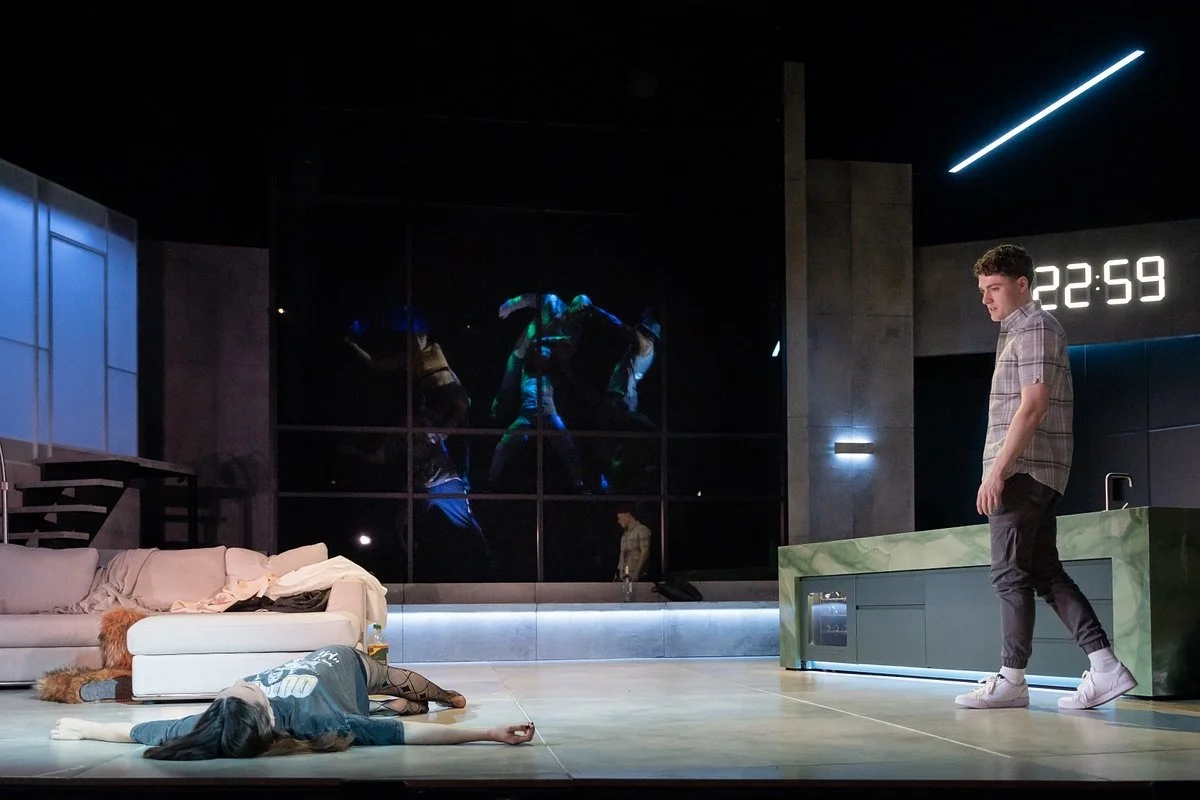
The House Party. Set design: Loren Elstein. Image: Ikin Yum
But what about quality?
With change can come concern.
Zoë remembers fears voiced initially that sustainable sets might affect the high-quality production values Headlong is known for. That reused materials would make for less polished sets and a rough-around-the-edges design and costumes.
“It just hasn’t been the case – when staging The House Party at Chichester Festival Theatre, we required a very slick, very expensive looking bachelor-pad kitchen-living room space. And that’s what we created, sustainably.”
Just the way we make theatre
When Zoë looks ahead to where the Green Book is taking Headlong, she links it to the changes we’ve already brought about around race and justice.
“We’ve reached a point as a company now where we don’t consciously think about casting a play in a more diverse way, it’s just the way we do it. Obviously, there are still challenges around it, and we work really hard with all our brilliant casting directors to do so, but it is just a no-brainer that’s ingrained in how we make work.
We’re well on our way to that with the Green Book – every year we’re finding out and learning more about how we can get there”
That’s where Headlong is heading – sustainable theatre-making as a non-negotiable, built-in process. Not an extra job – just the way we make theatre.
Zoë feels that there is something inherently Headlong in the idea of reusing, adapting, and transforming materials to take on new life.
“I find it really interesting when I watch a show to look at a set and know that that sofa or table or prop or costume has had a past life in another form, on another stage, at a different time. That it’s been used again and again in different ways. I think about the table in A Midsummer Night’s Dream for example, where had it been before it joined our production?
It’s compelling to me as this is a core element of what we do at Headlong in our work on classic plays. We take well-known, pre-loved stories, adapting and breathing life into them in new, relevant ways. There is something lovely about how that’s reflected in the very fabric of the sets, props and costumes that audiences see as part of their Headlong experience.
Take ROBOTA - our upcoming show in Oxford this summer. It is an adaptation of a Czech classic and is all about humans, AI and what lies in between.
It is also our first attempt at creating a show to Advanced Theatre Green Book standard. So our designer Loren (Elstein) is doing an incredible job of thinking about AI, thinking about sustainability and bringing the two together. AI pulls together lots of what is already out there, so from a creative angle it definitely works!”
It feels like there’s something circular in that as well. If this has piqued an interest in sustainable theatre making, you can go deeper by checking out the Theatre Green Book online.